
ChatGPT Ads Are Underperforming. Is Your Agency Paying Attention?

Marketing agency representative discusses advertising performance with a skeptical client as a chart shows contrasting results.

New research suggests paid ChatGPT advertising is underperforming compared to established digital marketing channels. But the bigger question isn’t whether ChatGPT ads work. It’s whether your marketing agency knows when to recommend emerging opportunities, when to test them, and when to invest your budget elsewhere.

7 Specific Things to Examine in Your 2027 Marketing Budget Before You Approve It

Marketing budget analysis workspace with a laptop, calculator, financial reports and a seven-point checklist.

If you’re responsible for a marketing budget, there’s a pretty good chance you’ve spent some quality time with a spreadsheet lately. Last week, I talked about why building a 2027 marketing budget requires looking at more than what you spent last year. If you haven’t read that one, you can find it here. But I’m […]

Why Referrals Alone Can’t Create Predictable Growth
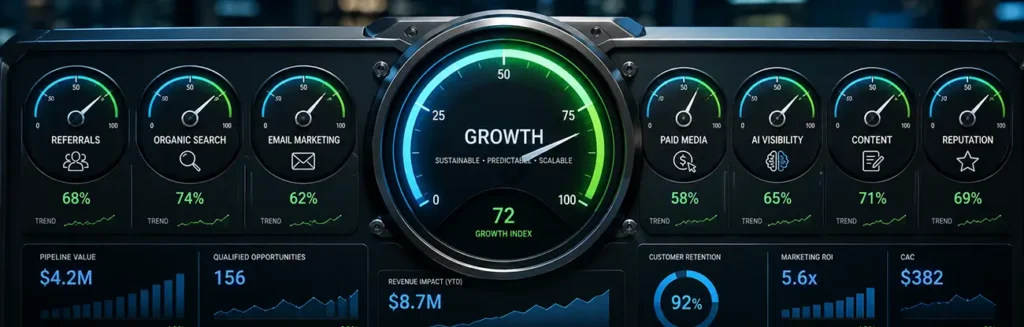
How Smart Marketers Build Predictable Growth I had an interesting conversation with a business owner the other night. He told me, proudly, that he had no need for digital marketing. "Every job we get comes from referrals," he said. "We've got more work than we can handle. I don't need SEO. I don't need advertising. I don't need any of that." My answer probably wasn't what he expected. "That's fantastic," I said. "I hope that never changes." Because he was right about one thing. Referrals are the best leads you'll ever get. They're warm. They're trusted. They close faster. They negotiate less. They often become your best long-term customers. Every company should strive to earn more referrals because they are the natural result of doing great work. But then I asked him a simple question. "Can you schedule one?" That's where the conversation changed. If your customers are talking about you, recommending you, and bringing new business to your door, you've built something worth celebrating. The problem isn't referrals. The problem is depending on something you can't control. You can't decide that next Tuesday is a good day for three great referrals to arrive. You can't increase referrals by 20 percent because next quarter's revenue target looks a little light. You can't flip a switch when a major customer leaves or the economy slows down. That's not a criticism of referrals. It's simply recognizing that referrals are a wonderful outcome, not a predictable business strategy. That means looking for single points of failure before they become business problems. Consider a few examples: One major customer. Losing them creates an immediate revenue problem. One top salesperson. If they leave, so does much of the pipeline. One trade show. Cancel it, and your lead generation disappears. One Google ranking. An algorithm change can erase years of momentum. One source of referrals. Great until that source retires, changes jobs, or simply has a quiet season. Smart marketers don't panic about these risks. They build systems that reduce their dependence on any one of them. They recognize the need for more predictable growth and immediately start adding marketing activities. A blog A podcast Google Ads - SEO - Email campaigns Social media - AI tools None of those things are bad ideas. But none of them, by themselves, create predictable growth. Buying Google Ads doesn't give you control. Launching a podcast doesn't give you control. Publishing blog posts doesn't give you control. Even investing in AI doesn't give you control. Without a strategy, measurable objectives, continuous optimization, and a relentless focus on ROI, they're just marketing activities. And activity should never be confused with progress. The companies that consistently outperform their competitors rarely have one magical marketing tactic. Instead, they've built a system. Each part supports the others. Content improves search visibility. Search attracts qualified prospects. Email nurtures relationships. Thought leadership builds credibility. Analytics identify what's working and what isn't. AI helps accelerate research, content development, and customer engagement. Most importantly, every piece is measured against one question. Is it producing business results? That's a very different conversation than asking whether your website gets more traffic or your latest social post generated more likes. Marketing should never exist simply because everyone else is doing it. It should exist because it helps the business grow. When referrals are strong, you can be more selective about the clients you pursue. When the economy softens, your pipeline doesn't suddenly disappear. When you're trying to recruit top talent, your reputation is already working for you. When buyer behavior shifts, whether it's search engines, social media, or AI-powered discovery, you've already built a marketing system that's capable of adapting. That's the real goal. Not replacing referrals. Not chasing every new marketing trend. Building a business that's less dependent on luck. Keep earning them. Keep asking for them. Keep celebrating them. But don't confuse a strong referral network with a predictable growth strategy. Ask yourself: • If referrals slowed down for the next six months, what marketing system would continue bringing qualified opportunities to our business? • Are our marketing investments tied to measurable business outcomes, or are we simply checking boxes? • Are we investing in disconnected tactics, or are we building an integrated system designed to produce long-term ROI? Marketing isn't about replacing your best source of business. It's about making sure your business continues to grow even when your best source has a slow month. Because the smartest marketers don't build businesses that depend on hope. They build businesses that are designed to grow.

I had an interesting conversation with a business owner the other night. He told me, proudly, that he had no need for digital marketing. “Every job we get comes from referrals,” he said. “We’ve got more work than we can handle. I don’t need SEO. I don’t need advertising. I don’t need any of that.” […]

How Smart Marketers Know What to Do Next

Marketing strategist reviewing interconnected AI, podcast, analytics, search, and custom tool opportunities on a blackboard

When your marketing is already working, deciding what to do next can be harder than fixing what’s broken. Learn how smart marketers evaluate new opportunities, avoid diminishing returns, and justify the investments most likely to create real value.

Skip to content