

AI in marketing is no longer experimental. It is operational. It is infrastructure. And the data shows that adoption is accelerating.
Most organizations are already using AI somewhere in their business. Roughly 78 percent report active use in at least one core function. Nearly 70 percent of marketers say AI is now part of their day-to-day operations. Close to 90 percent of digital marketers report using AI regularly, and more than 90 percent of companies plan to increase their investment in generative AI tools over the next several years.
That level of adoption changes the conversation. We are no longer debating whether AI belongs in marketing. The real discussion is where it creates the most leverage.
Two areas are moving especially fast: AI-driven engagement through agents, and AI-assisted content amplification.
Agents Are Not Chatbots
Traditional chatbots were built around scripts and decision trees. They answered predictable questions reasonably well, but they struggled when the conversation moved beyond a narrow path.
AI agents are built differently. They pull from structured knowledge sources. They retrieve verified information from indexed documentation. They understand context. They ask clarifying questions. They adjust their tone and depth depending on who they’re speaking with.
In practical terms, that means the interaction feels less like a gatekeeper and more like a guide. Instead of blocking the user until they choose the right menu option, the agent helps them move forward.
When implemented properly, that shift affects sales qualification, distributor engagement, and customer support in measurable ways.
AI Content Is an Amplifier
The same evolution is happening with content.
AI-generated podcasts, AI-assisted blogs, and AI-supported campaigns are not shortcuts when they are handled correctly. They are amplifiers. They allow marketing teams to extend expertise across more channels, more consistently, without sacrificing quality.
Recent surveys show that roughly 85 percent of marketers are already using AI for content creation. Teams leveraging AI are often producing substantially more content than before, in some cases over 40 percent more per month. Many also report improved campaign performance and efficiency when AI is used to support research, structure, and workflow.
Used thoughtfully, AI does not replace subject matter expertise. It helps distribute it. Here are two examples of how that plays out in the real world with clients who chose to lean into it early, and are already seeing the difference.
Lippmann – Lippmann Academy CrushCast

Lippmann builds rock crushing machinery for serious buyers who expect detailed information. Their Head of Marketing, Kelly Blickle, recognized that podcast media could become more than a brand exercise. It could be a teaching platform.
The result is the Lippmann Academy CrushCast. Each monthly episode focuses on a specific machine model, diving into specifications, performance characteristics, and competitive positioning. AI co-hosts Nick and Jessica guide the discussion in a structured format that makes complex information accessible without oversimplifying it.
The production quality reflects national radio standards, with professional pacing, clean voice work, music beds, and thoughtful sound design. This is not background noise. It is intentional communication.
The first three episodes generated close to 750 downloads, with listeners from around the world. Internally, the response has been strong. One executive commented, “I want to believe we will be market leaders with this kind of content.” The series is now used for team education and distributor training, and it will support live events such as ConExpo, where attendees can listen to episodes about the machines they are viewing on the floor.
This is a clear example of AI being used to amplify product expertise rather than dilute it. Kelly was recently recognized with Lippmann’s POWER Award for elevating the brand and strengthening awareness across customers and dealers. Was the CrushCast part of that momentum? I’m sure it didn’t hurt.
Heresite – Herry the AI Agent
Heresite manufactures highly specialized industrial coatings for technical and global markets, where buyers often need detailed answers before speaking with a sales representative. Kayla Oehldrich, Heresite’s Sales & Marketing Manager, saw how Webster was working on Trivera’s site and recognized that a similar approach could meaningfully improve that early-stage interaction for her team.
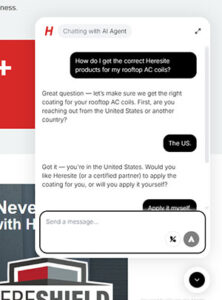 Herry, Heresite’s AI agent, was designed to improve that early-stage interaction.
Built on a RAG architecture, it indexes Heresite’s technical documentation as its source of truth. Instead of relying on generic responses, it retrieves verified information and communicates it in a way that matches the user’s needs. Engineers can receive direct, concise answers. Others may receive a more guided explanation.
More importantly, Herry engages in conversation. It asks follow-up questions to clarify applications. It helps determine whether a project is do-it-yourself or requires a coating partner. It assists with locating international distributors. It recognizes when a discussion is turning into a legitimate sales opportunity.
Behind the scenes, custom back-end programming routes qualified conversations directly to the sales team, complete with structured summaries and full transcripts. Each interaction is logged and analyzed, allowing for continuous refinement of the knowledge base and reporting on usage patterns, inquiry types, and conversion signals.
After two months in service, Herry is seeing increasing, lead-generating engagement. It is not viewed as a chatbot. It is treated as an extension of Heresite’s customer service and sales qualification process — a reflection of Kayla’s early decision to invest in something more strategic than a standard website feature.
What This Means for Marketing Leaders
AI is not a standalone tactic. It is becoming part of the operating system of modern marketing.
In some organizations, it will support content scale and authority. In others, it will improve lead qualification and customer engagement. In many cases, it will do both.
The important question is not whether AI is relevant. The adoption data already answers that. The question is how deliberately it is being integrated into your strategy.
When treated as infrastructure rather than novelty, AI has the potential to strengthen positioning, improve efficiency, and create measurable business impact.
The marketers who approach it that way are already seeing the difference.
Sources
McKinsey & Company, The State of AI: Link
Salesforce, State of Marketing Report: Link
HubSpot, State of AI in Marketing Report: Link
IBM, Global AI Adoption Index: Link
McKinsey & Company, The Value of Getting Personalization Right: Link